Introduction
Pakistan’s commercial real estate sector has grown rapidly over the past decade, driven by urbanization, rising business activity, and increasing investment in cities like Lahore, Karachi, and Islamabad. From corporate offices to shopping plazas and warehouses, commercial buildings in Pakistan come in many forms — each with its own design requirements, construction approach, and regulatory considerations.
This guide breaks down the major types of commercial buildings found across Pakistan, what makes each one unique, and what to consider when planning or investing in one.
What Qualifies as a Commercial Building?
A commercial building is any structure primarily used for business or income-generating activities rather than private residential living. This includes buildings used for offices, retail, hospitality, healthcare, education, and industrial operations. Commercial buildings are generally subject to stricter building codes, fire safety regulations, and zoning requirements than residential structures, given their higher occupancy and public-facing use.
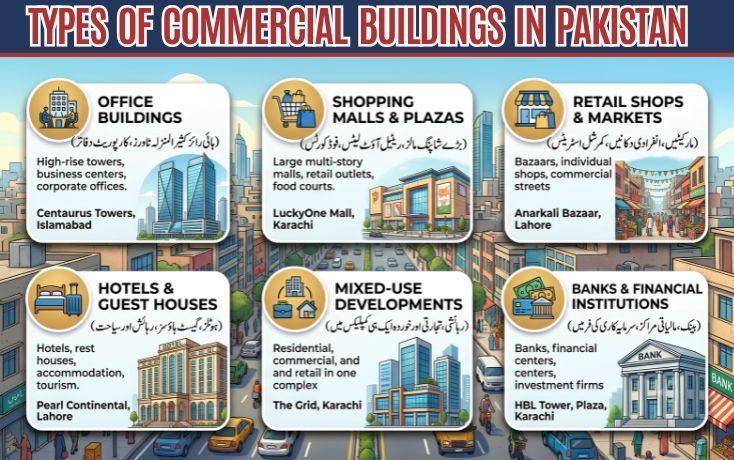
Major Types of Commercial Buildings in Pakistan
1. Office Buildings
Office buildings range from small standalone offices to large corporate towers housing multiple businesses. Common features include:
- Open-plan or partitioned workspaces
- Reception and meeting room areas
- Elevators and parking facilities for multi-story buildings
- Strong electrical and IT infrastructure to support modern business operations
Common in: Business districts across Lahore, Karachi, and Islamabad, including areas like Gulberg, DHA, and Blue Area.
2. Retail Buildings and Commercial Plazas
Retail construction includes standalone shops, shopping plazas, and larger shopping malls. Key design priorities include:
- Storefront visibility and signage space
- Efficient customer flow and layout
- Adequate parking and accessibility
- Flexible interior space for different tenant requirements
Common in: High-traffic commercial roads and housing society commercial zones across major cities.
3. Hospitality Buildings
This category covers hotels, guest houses, restaurants, and banquet halls. Hospitality construction requires special attention to:
- Guest comfort and interior finishing standards
- Commercial-grade kitchen and safety systems for restaurants
- Fire safety and emergency exit planning for higher occupancy
- Aesthetic design that reflects brand identity
Common in: City centers, tourist areas, and along major commercial corridors.
4. Warehouses and Industrial Buildings
Warehouses, factories, and distribution centers prioritize function over form, with construction focused on:
- Large open floor plans for storage or production
- Heavy-duty flooring and structural load capacity
- Loading docks and vehicle access
- Ventilation and safety systems suited to industrial use
Common in: Industrial zones and outskirts of major cities, such as areas along major highways and ring roads.
5. Healthcare Buildings
Hospitals, clinics, and diagnostic centers require highly specialized construction, including:
- Strict ventilation and sanitation standards
- Accessibility features for patients with mobility challenges
- Specialized electrical and plumbing systems for medical equipment
- Clear separation of patient, staff, and emergency access areas
Common in: Urban centers and areas with strong residential density requiring accessible healthcare services.
6. Educational Buildings
Schools, colleges, and universities fall under commercial/institutional construction, with a focus on:
- Classroom and lecture hall layouts
- Safety features appropriate for large numbers of students
- Outdoor and recreational space planning
- Durable, low-maintenance materials suited to high daily use
Common in: Residential society commercial zones and dedicated education corridors in major cities.
7. Mixed-Use Developments
Mixed-use buildings combine two or more functions — commonly retail and office space, or commercial and residential units — within a single development. These require careful planning to balance:
- Separate access points for different building uses
- Shared parking and utility infrastructure
- Zoning compliance for combined use types
- Coordinated design between commercial and residential sections
Common in: Growing urban corridors and newer housing societies looking to combine residential living with nearby commercial convenience.
Comparison Table: Types of Commercial Buildings in Pakistan
| Building Type | Primary Use | Key Design Priority | Typical Construction Complexity |
|---|---|---|---|
| Office Buildings | Business operations | IT infrastructure, workspace efficiency | Moderate to High |
| Retail/Plazas | Shopping, storefronts | Foot traffic flow, visibility | Moderate |
| Hospitality | Hotels, restaurants | Guest experience, kitchen safety | Moderate to High |
| Warehouses/Industrial | Storage, manufacturing | Structural strength, load capacity | Moderate |
| Healthcare | Medical services | Sanitation, accessibility | High |
| Educational | Schools, colleges | Safety, durability | Moderate |
| Mixed-Use | Combined commercial/residential | Zoning, shared infrastructure | High |
Key Regulatory Considerations for Commercial Buildings in Pakistan
Regardless of type, commercial buildings in Pakistan generally require:
- Approval from relevant development authorities (such as LDA in Lahore or similar authorities in other cities)
- Compliance with fire safety and building codes appropriate to occupancy levels
- Zoning verification, confirming the land is designated for commercial or mixed-use purposes
- NOCs (No Objection Certificates) for specific building types, especially healthcare and hospitality projects
- Structural approval from qualified engineers, particularly for multi-story or high-occupancy buildings
Skipping or delaying these approvals is one of the most common causes of construction delays and legal complications for commercial projects in Pakistan.
Cost Considerations Across Commercial Building Types
Construction costs vary significantly depending on the building type, primarily due to differences in structural requirements and specialized systems:
| Building Type | Relative Cost Level | Key Cost Drivers |
|---|---|---|
| Office Buildings | Moderate to High | MEP systems, elevators, interior fit-out |
| Retail/Plazas | Moderate | Storefront design, flexible interior finishing |
| Hospitality | High | Kitchen systems, guest-focused finishing, fire safety |
| Warehouses/Industrial | Lower to Moderate | Structural materials, floor load capacity |
| Healthcare | High | Specialized systems, sanitation, accessibility features |
| Educational | Moderate | Durable materials, safety features |
| Mixed-Use | High | Combined zoning and infrastructure requirements |
For a general benchmark, many commercial projects in cities like Lahore are estimated using a per-square-foot rate that varies by finishing tier — commonly ranging from standard (A-Category) to premium pricing, depending on material quality and design complexity.
Choosing the Right Construction Company for Your Commercial Building
Because commercial buildings vary so widely in requirements, it’s important to choose a construction company with experience specific to your building type. Key factors to evaluate include:
- Relevant project experience with your specific commercial building type
- In-house design and engineering capability, reducing coordination issues between architects and contractors
- Transparent, itemized pricing that clearly outlines what’s included in the quoted rate
- Familiarity with local approval processes for your building type and city
- Strong project management systems, including regular updates and quality control
Companies offering an integrated design-build approach — such as Z. Construction & Designs — can be particularly valuable for commercial projects, since they combine architectural planning with construction execution under one accountable team, helping reduce delays and miscommunication across complex builds.
Frequently Asked Questions (FAQs)
1. What are the most common types of commercial buildings in Pakistan?
The most common types include office buildings, retail stores and plazas, hospitality buildings (hotels and restaurants), warehouses, healthcare facilities, educational institutions, and mixed-use developments.
2. Which type of commercial building is the most expensive to construct?
Healthcare and hospitality buildings tend to be among the most expensive due to specialized systems, strict safety requirements, and higher-quality finishing standards.
3. Do all commercial buildings require the same approvals?
No. While most require basic building and zoning approvals, certain types — like healthcare facilities and restaurants — require additional NOCs and safety certifications specific to their use.
4. Can one construction company build different types of commercial buildings?
Yes, though it’s important to confirm the company has specific experience with your building type, since requirements for a warehouse differ significantly from those for an office building or hospital.
5. What is a mixed-use commercial building?
A mixed-use building combines two or more functions — such as retail and office space, or commercial and residential units — within a single development, requiring careful zoning and infrastructure planning.
6. How do I choose the right commercial building type for my investment?
This depends on your target market, budget, and location. Retail and office buildings tend to have broader demand, while healthcare and hospitality require more specialized planning and higher upfront investment.
Understanding the different types of commercial buildings in Pakistan — from offices and retail plazas to warehouses, healthcare facilities, and mixed-use developments — helps investors and business owners plan more realistic budgets, timelines, and design approaches. Each building type comes with its own regulatory requirements, cost drivers, and construction complexity, making it essential to work with a construction company experienced in your specific project type.
Whether you’re planning an office, a retail plaza, or a mixed-use development, partnering with an experienced team — like Z. Construction & Designs — can help you navigate design, approvals, and construction with greater confidence and fewer surprises along the way.