Introduction
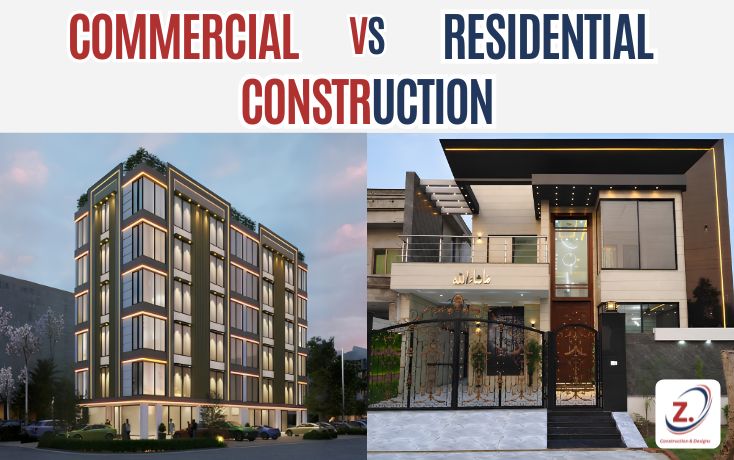
Construction is construction, right? Not quite. While both commercial and residential construction involve turning a design into a physical structure, the two fields differ significantly in scale, materials, regulations, and overall process. Understanding these differences matters whether you’re a homeowner planning a house, a business owner developing an office or retail space, or simply trying to choose the right construction company for your project.
This guide breaks down the key differences between commercial and residential construction, when each type applies, and what to consider when hiring a construction partner for either type of project.
What Is Residential Construction?
Residential construction refers to the building of structures intended for private living — houses, apartments, townhouses, and villas. It’s generally focused on:
- Comfort, privacy, and family living
- Personalized design based on homeowner preferences
- Simpler, smaller-scale structural requirements
- Standard building codes for single-family or multi-family homes
Residential projects are usually smaller in scale and shorter in duration compared to commercial builds, and they’re typically funded directly by individual homeowners or families.
What Is Commercial Construction?
Commercial construction refers to the building of structures intended for business use — offices, retail stores, restaurants, hotels, warehouses, and mixed-use developments. It’s generally focused on:
- Supporting business operations and higher foot traffic
- Compliance with stricter safety, fire, and accessibility codes
- More complex structural engineering for larger spans and multi-story designs
- Advanced MEP (mechanical, electrical, plumbing) systems, including HVAC and fire suppression
Commercial projects are typically larger, more complex, and involve longer timelines than residential builds, often funded by businesses, investors, or developers.
Key Differences Between Commercial and Residential Construction
| Factor | Residential Construction | Commercial Construction |
|---|---|---|
| Purpose | Private living spaces | Business and public-use spaces |
| Scale | Smaller, single-family focus | Larger, multi-use or multi-story |
| Materials | Wood framing, standard brick/block | Steel, reinforced concrete, composite materials |
| Regulations | Standard residential building codes | Stricter commercial and fire safety codes |
| Systems | Basic electrical and plumbing | Complex MEP systems, HVAC, fire suppression, elevators |
| Timeline | Typically shorter (months) | Often longer (many months to years) |
| Budget | Lower overall investment | Higher overall investment |
| Design Priority | Comfort, aesthetics, family needs | Functionality, foot traffic, brand identity |
| Funding Source | Individual homeowners/families | Businesses, investors, developers |
| Approval Process | Generally simpler permitting | More extensive approvals (fire, zoning, occupancy) |
Differences in Materials and Structural Design
Residential Construction Materials
Residential buildings typically rely on materials chosen for comfort, cost-efficiency, and aesthetics — such as wood framing, standard brick or block masonry, and conventional roofing systems suited to single or double-story homes.
Commercial Construction Materials
Commercial buildings require materials built for durability, larger structural spans, and higher load capacity — commonly steel framing, reinforced concrete, and composite materials designed to support multi-story structures and heavier usage over time.
Differences in Regulations and Approvals
Residential construction generally follows standard local building codes, with a relatively straightforward permitting process for houses and small multi-family units.
Commercial construction, on the other hand, must comply with stricter requirements, including:
- Fire and life-safety codes appropriate for higher occupancy
- Accessibility requirements for public-facing spaces
- Zoning laws specific to commercial or mixed-use land
- Additional approvals related to signage, parking, and occupancy limits
This is one reason commercial projects often take longer to move from design to construction — the approval process itself is more involved.
Differences in Project Timeline and Complexity
| Stage | Residential | Commercial |
|---|---|---|
| Design & Planning | Weeks to a couple of months | Several months, often including feasibility studies |
| Approvals | Relatively quick | Can take significantly longer due to multiple regulatory checks |
| Construction | A few months to about a year | Several months to multiple years, depending on scale |
| Systems Installation | Basic electrical/plumbing | Complex MEP systems requiring specialized contractors |
| Handover | Single-family walkthrough | Often phased handover across multiple units or tenants |
Differences in Cost
Commercial construction is generally more expensive per square foot than residential construction, due to:
- Higher-grade structural materials and reinforcement
- More complex MEP systems (HVAC, fire suppression, elevators)
- Stricter code compliance requirements
- Larger-scale project management and coordination needs
Residential construction costs are typically lower per square foot, though final costs still vary significantly based on the quality tier chosen — Economy, Standard, Premium, or Luxury — and the specific location and design complexity of the project.
Who Needs Commercial Construction vs Residential Construction?
Choose Residential Construction If You’re:
- Building a personal home for you or your family
- Renovating or expanding an existing house
- Developing a small number of residential units for personal use or rental
Choose Commercial Construction If You’re:
- Building an office, retail store, or restaurant
- Developing a warehouse or industrial facility
- Constructing a hotel, plaza, or mixed-use commercial building
- Investing in property specifically for business or commercial rental purposes
Can One Construction Company Handle Both?
Yes — some construction companies specialize in only one type, while others, like Z. Construction & Designs, offer experience across both residential and commercial projects. This flexibility can be a major advantage for clients who:
- Are developing mixed-use properties combining residential and commercial space
- Want a single trusted construction partner for multiple types of projects
- Value a design-build approach where architecture and construction are handled together, regardless of project type
When evaluating a construction company for either type of project, it’s important to confirm they have specific, relevant experience — a company skilled in family homes isn’t automatically equipped for the structural and regulatory complexity of a commercial build, and vice versa.
Questions to Ask a Construction Company Before Hiring
- Do you have direct experience with residential, commercial, or both types of projects?
- Can you provide examples of completed projects similar to mine?
- What is your typical timeline for a project of this scale and type?
- Do you offer integrated design and construction services?
- How do you handle regulatory approvals specific to my project type?
- Can you provide a detailed, itemized cost estimate?
Frequently Asked Questions (FAQs)
1. What is the main difference between commercial and residential construction?
Residential construction focuses on private living spaces and is generally smaller in scale and simpler in regulation, while commercial construction focuses on business-use spaces and involves stricter codes, more complex systems, and larger budgets.
2. Is commercial construction more expensive than residential construction?
Generally, yes. Commercial construction typically costs more per square foot due to stricter building codes, more complex MEP systems, and higher-grade structural materials.
3. Do commercial and residential construction use the same materials?
Not usually. Residential construction often relies on wood framing and standard masonry, while commercial construction typically uses steel framing, reinforced concrete, and composite materials suited to larger structures.
4. Can the same construction company handle both commercial and residential projects?
Yes, some companies — including design-build firms like Z. Construction & Designs — handle both types of projects, though it’s important to confirm relevant experience for your specific project type.
5. Which type of construction takes longer to complete?
Commercial construction generally takes longer due to its larger scale, more complex systems, and more extensive regulatory approval process compared to most residential projects.
6. Do commercial buildings require different approvals than residential buildings?
Yes, commercial buildings typically require additional approvals related to fire safety, accessibility, zoning, and occupancy limits, beyond the standard permitting process for residential homes.
While commercial and residential construction share the same basic goal — turning a design into a safe, functional structure — they differ significantly in scale, materials, regulations, and cost. Residential construction prioritizes comfort and personalization for private living, while commercial construction demands stricter compliance, more advanced systems, and larger-scale project management for business use.
Understanding these differences helps you set realistic expectations for your project’s timeline and budget, and choose a construction company — like Z. Construction & Designs — with the right experience for your specific type of build, whether residential, commercial, or both.